April 28, 2012

Butterflies Day 2 -Caterpillar Anatomy

Caterpillar Anatomy
1. Discuss: Butterflies do all of their growing during the larva stage (caterpillar).  Like all insects they have three distinct body parts (head, thorax, and abdomen).  The head has a pair of short antennae, mouth parts (upper lip, mandibles, and lower lip), and six pairs of simple eyes, called ocelli, that can detect light and dark. Even with all of these eyes, the caterpillar's vision is poor. Each body section has a pair of jointed, called true legs, while some of the abdominal segments have false legs, called prolegs. The body has tiny holes that the caterpillar uses to breath called spiracles. The caterpillar also has tiny hairs along his body that sense touch called setae

2. Read: Creepy, Crawly Caterpillars by Margery Facklam
 
3. Comprehension questions:
  • What are the 3 body parts of a caterpillar (and all insects)? Head, Thorax, Abdomen
  • What are the stumpy false legs called? Prolegs
  • What is the jaw located on the head called? Mandibles
  • What are the tiny hairs along his body that sense touch? Setae
  • What are the simple eye organs that can detect light and dark? Ocelli
  • What are tiny holes that the caterpillar uses to breath? Spircles
Caterpillar Math Game
I found a elementary Caterpillar Math Game that J liked to play.  You just need to get a file folder and tape in copies of the number caterpillar.  I colored mine to make it look more fun.  
Then you just cut out different addition and subtraction facts for your child to match up with the correct numbers on the caterpillar board.  I also laminated the folder and all the pieces.

Edible Caterpillar Cocoons
Ingredients:
1- 8 oz. tube refrigerated crescent rolls
4 hotdogs
1 ketchup

Directions:
Preheat oven according to directions on the crescent-roll package. Separate the crescent-roll dough into its pre-cut triangle pieces, and lay them flat. 
Cut the hot dogs in half and place one half hotdog on each crescent-roll. Roll and bake on a cookie sheet according to package instructions. Dip in ketchup and enjoy.
What a fun lunch for the kids, and for dessert I had made caterpillar cupcakes for them.
Label the Caterpillar Parts
We did the Label the Caterpillar Parts diagram to review what we had learned today.  I used the diagram in the front of Creepy, Crawly Caterpillars by Margery Facklam and the Caterpillar Anatomy page to help with the review.

 
Egg Carton Spelling
Materials:
  • Egg cartons
  • Green, purple, yellow, white paint
  • Paintbrush
  • Google eyes
  • Pipe Cleaners
Directions:
  1. Cut the bottoms off of a couple of empty egg cartons.
  2. Paint them green, purple, and yellow. 
  3. After they dry, turn the green ones into heads, with goggle eyes and pipe cleaner antennae.
  4. Paint letter on top of the yellows (two sets of vowels), and purples (only one set of consonants.) 
  5. After those dry, you can practice your alphabet, and simple spelling skills.
  6. We used them to review our spelling words for the week.

    Caterpillar Poem

               Caterpillar
    Fuzzy, wuzzy, creepy crawly
    Caterpillar funny 
    You will be a butterfly
    When the days are sunny.
    Wiggling, flinging, dancing, springing 
    Butterfly so yellow, 
    You were once a caterpillar,
    Wriggly, wiggly, fellow.
    by Lillian Vabada
    Read the poem and write down all rhyming words from the poem below.

           1.
    __________________________________________________________
           2.
    __________________________________________________________
           3.
    __________________________________________________________
           4.
    __________________________________________________________
           5.
    __________________________________________________________
           6.
    __________________________________________________________

Butterflies Day 1 -Life Cycle

Butterfly & Moth Life Cycle
1. Discuss: Ask the children “How do butterflies and moths grow? Do they start out as little babies like us or from eggs like snakes, frogs, turtles, and birds?” Because butterflies and moths are insects they start as an egg. When the egg hatches the butterfly or moth is called a caterpillar or larva. Caterpillars spend most of their time feeding on plants and grow very quickly. A caterpillar grows into a pupa. A butterfly pupa is called a chrysalis and a moth pupa is a cocoon. What do you think happens to the pupa inside a chrysalis or cocoon? The pupa is turning into a butterfly or a moth. This process of change from caterpillar to butterfly or moth is called metamorphosis. Have the children repeat the word “metamorphosis.” During the pupa stage the transformation from larva to adult is completed. Butterflies make a chrysalis to protect them as pupae. Many butterfly pupae are well-camouflaged, since they can't escape from predators by flying away. Just before the butterfly emerges, you can see their wing patterns through the pupa covering. The pupa stage usually last ten to fourteen days.

2. Read: Caterpillar to Butterfly by Camilla de la Bedoyere

3. Review: Review the butterfly life cycle with hand motions. What is the first stage in a butterfly’s metamorphosis? An egg (hand clutched tight in a fist). What is the second stage of a butterfly’s metamorphosis? A caterpillar (index finger extended, scrunched, extended, scrunched). What is the third stage of a butterfly’s metamorphosis? A chrysalis (index finger wrapped by other hand-like a hotdog). What is the last stage of a butterfly’s metamorphosis? A butterfly (thumbs interlocked, fingers wiggling and making a flying motion).

4. Comprehension questions: What are the 4 stages of butterfly or moth metamorphosis? Egg, larva (caterpillar), pupa (chrysalis or cocoon), adult (butterfly or moth)
 
Butterfly Life Cycle Craft
Materials:
  • Clothespin
  • Small pom-poms
  • Google eyes
  • Pipe cleaner
  • Glue
  • Toilet paper tube
  • Green tissue paper
  • Another color tissue paper
  • Tape
Directions:
1. Glue pompoms to clothespins with google eyes, and a piece of bent pipe cleaner for the antennae. 
2. Make the chrysalis by gluing green tissue paper squares onto toilet paper rolls. When they are completely covered and dry, staple one end closed. 
3. Make wings for the butterflies by pinching rectangles of tissue paper, and taping them in the middle, to fit in the center of the clothes pins. 
4. With the addition of a tiny pompom "egg", you can discuss the butterfly life cycle.
5. Fold the wings up, and stuff them into the toilet paper rolls with the tape end up.
You can act out how the butterfly wraps itself in the chrysalis shell, and then emerges, after a few weeks, with it's wings crumpled, and wet. To sun itself, and gradually dry, and straighten out it's wings, ready to fly. 

Life Cycle Metamorphosis Activity
Materials:
-Drawing Paper
-Scissors
-Crayons

Directions:
1.  Fold a piece of paper in half.
2.  Draw a kidney bean shaped figure along the folded half.
3.  Cut out the figure.
4. Unfold the figure, draw, and color a butterfly on one side of the paper.
5.  Fold the paper in half again with the blank sides facing out.  Draw and color a caterpillar on one side.
6.  Flip the folded paper over to the other blank side.  Draw and color a chrysalis on this side.

Label a Life Cycle
I used the Label a Life Cycle form to review the stages of metamorphosis.  We also used page 33 of Butterflies and Moths to help with the review.

adult - the winged adult will lay the eggs. Adults do not eat, they only sip liquids through a straw-like proboscis.
larva - also called the caterpillar hatches from the egg. The larva spends its time eating, growing and molting (shedding its outgrown exoskeleton).
pupa - the stage in a butterfly's life when it is encased in a chrysalis and undergoes metamorphosis into the adult.
egg - the tiny orb laid by a female butterfly. Eggs are usually laid on the underside of leaves - they hatch into larvae.
 

Butterfly Life Cycle Picture Wheel
Materials:
  • Bowl with about 8 inch diameter
  • 2 pieces of cardstock
  • Pencil
  • Scissors
  • Crayons or markers
  • Glue stick
  • Copy of butterfly life cycle pictures
  • Paper fastener
Directions:
  1. Place the bowl upside on the cardstock and trace a circle around it. Do this to both pieces of the cardstock. Add a little handle to the wheel. Cut out both pieces.
  2. Cut a triangle out of one wheel with the tip of the triangle almost to the center of the wheel as pictured.
  3. Color the life cycle pictures and then cut them out.
  4. Have the children sequence the pictures in the correct order to help with the next step.
  5. Glue the pictures in order around the whole wheel.
  6. Punch a whole in the center of the 2 wheels and place the one with the triangle cut out on the top.
  7. Connect the wheels with a paper fastener.
Butterfly Story
I found this Butterfly Story page to color and practice some writing.

Butterfly Unit Study

In this unit study we learned about the life cycle of butterflies and moths, the anatomy of butterflies and moths, and the differences between butterflies and moths.  We also grew a butterfly and record our observations.  This unit study has 4 days worth of lessons, and it takes 3 to 4 weeks to grow the butterfly.  I did this unit study with my 1st grader and I recommend it for Kindergarten to 3rd grade.
Butterfly Unit Study
Books can be read by the child or by the parent to the child, depending on the child's reading level. I don't think that a child is ever too old to be read to.

Books I used in the lessons...
Waiting for Wings by Lois Ehlert
Creep, Crawly Caterpillars by Margery Facklam
Caterpillar to Butterfly by Camilla de la Bedoyere
What's the Difference Between a Butterfly and a Moth? by Robin Koontz

Other age appropriate books...
Butterfly Story by Anca HaritonButterfly House by Eve Bunting 
The Lamb and the Butterfly illustrated by Eric Carle
Painted Lady Butterflies by Martha E. H. Rustad
The Magic School Bus the Butterfly and the Bog Beast by Nancy E. Krulik and Thompson Brothers
Can You Tell a Butterfly from a Moth by Buffy Silverman
Book List

Butterfly Video List
Wild Kratts Episode 109 Voyage of the Butterflier XT

http://video.nationalgeographic.com/video/kids/animals-pets-kids/bugs-kids/butterflies-kids/ (Web Video)

http://www.youtube.com/watch?v=9vXmF5W_Wkc (Web Video)

The Magic School Bus Season 2 Episode 5 – Butterfly and the Bog Beast (VHS)


Live Butterfly Garden
We got a Butterfly Garden from www.insectlore.com.  When we got the kit we sent for the caterpillars.  They came in about a week.
There were 4 tiny caterpillars in a container with food and air holes in it.  We did not have to open the container at all.
J recorded his observations of the caterpillars in a home made butterfly journal.  He wrote an update every other day or so; he also drew a picture for each journal entry.
On day 10 two of the caterpillars hung from the top of the container in a "J" form.
By day 12 all four of them were hanging form the top in their chrysalis'.  And on day 14 we opened he container and gently moved the piece of paper under the lid that they were hanging from.  I pinned it onto the mesh sides of the butterfly house.
 Finally on day 20 one emerged from the chrysalis. Then a few days later we set them free outside.

Catch Your Own Caterpillars
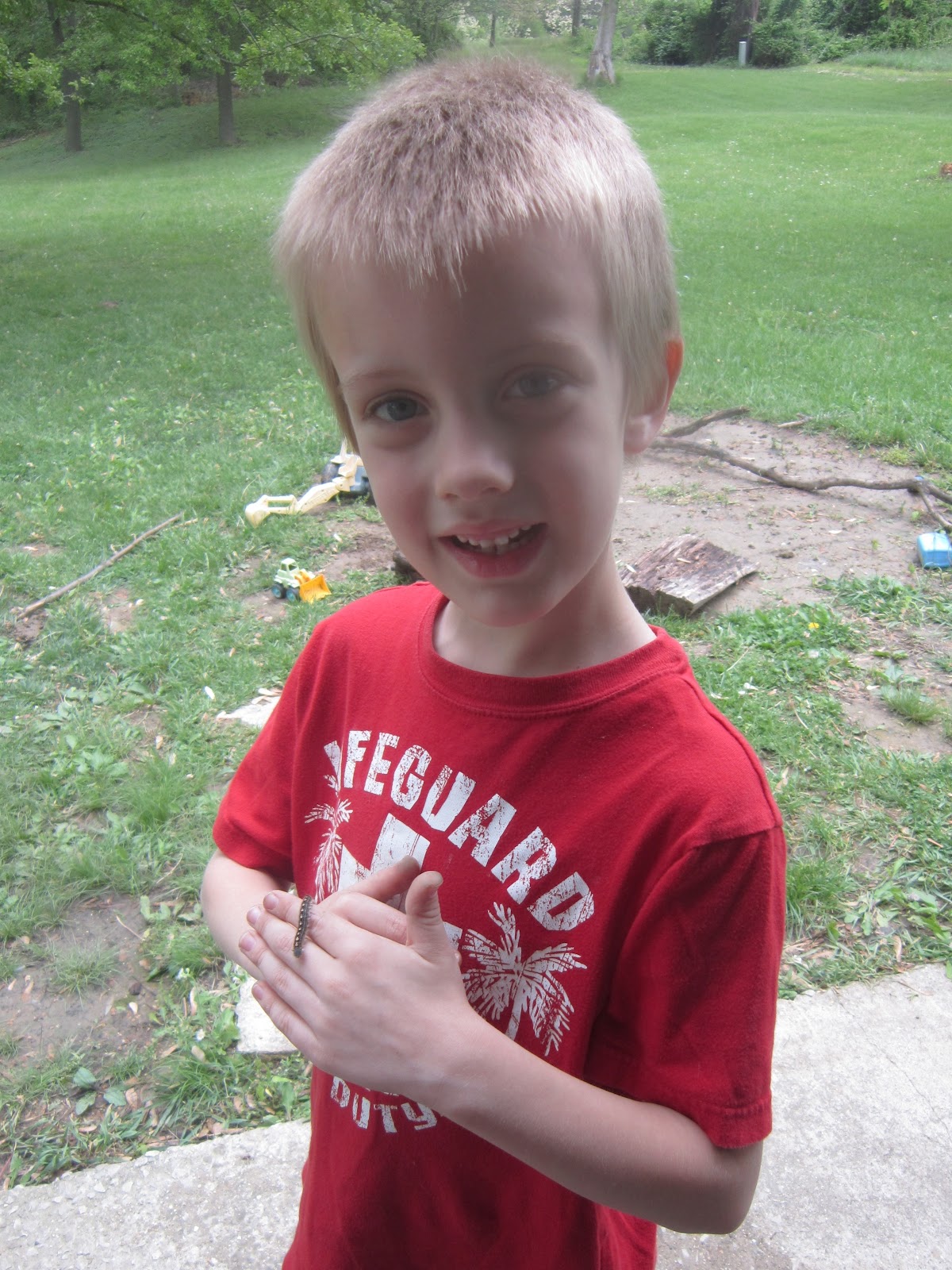
We also caught our own caterpillars and put them in our butterfly house to see what would happen. 
We caught 3 that looked the same and had formed cocoons by the next morning.  We also caught 2 other types of caterpillars that we had to feed leaves for a week.  Since they were in the grass when we found them we took a few leaves from the different trees in our yard to see which type they would eat.  Then we added new leaves from that tree every day.
The moths came out of the cocoons about 18 days after they made them.   

The Butterfly House 
We also took a trip to the St. Louis Butterfly House.  They had tons of beautiful butterflies and flowers.
 The boys really enjoyed seeing all the different types of butterflies.
They also had a chrysalis viewing area.  We saw one butterfly hanging on his empty chrysalis pumping his wings.
There was a 15 minute video to watch about the life of a butterfly and a world map outline that showed where different types of butterflies lived.
Outside there was a huge stone caterpillar that they boys could play on.
The whole visit was only about an hour, but it was fun to see all the different kids of butterflies, my favorite was the blue morpho butterfly (I didn't get a picture of one with open wings though).